Lesson one
Hold it, sit with it, tune it
Before a single note matters, four things decide whether guitar feels easy or painful: how you sit, how the guitar sits on you, how you hold the pick, and whether you are in tune. This page teaches all four.
Posture: how to sit and hold the guitar
Good posture is not about looking correct — it decides how far your fingers can reach and whether your wrists hurt after ten minutes.
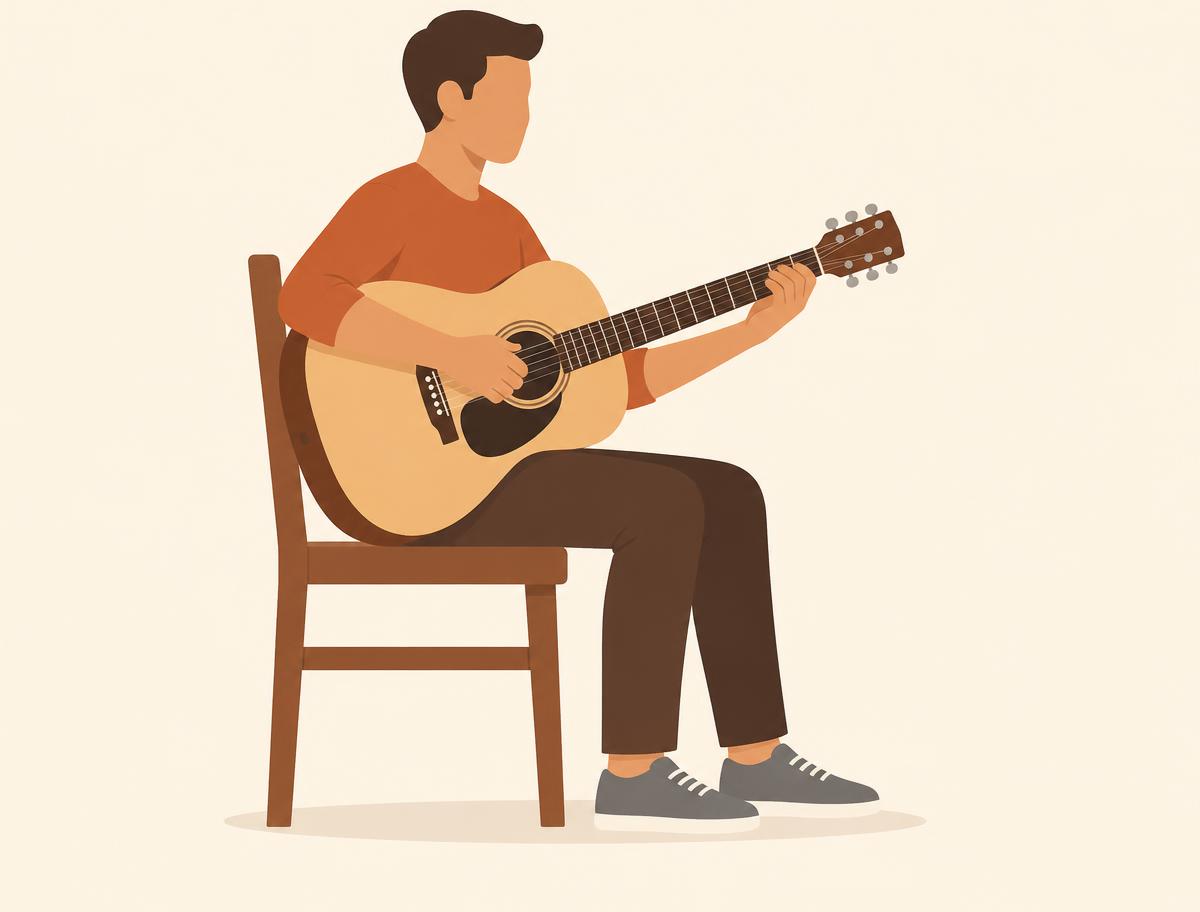
- ✓Sit on a firm, straight chair — not a soft sofa — with both feet flat on the floor.
- ✓Rest the guitar's waist on your right thigh (left thigh if you play left-handed), with the neck pointing up and slightly left.
- ✓Let the back of the guitar body touch your chest; the top of the body should sit around the middle of your ribs.
- ✓Bring the guitar to you — do not hunch your shoulders or crane your neck down to reach it.
- ✓Keep your back straight and your shoulders relaxed and down, not bunched up near your ears.
- ✓Hold the neck with your fretting hand lightly: thumb behind the neck, fingers curved over the fretboard.
- ✓Rest your picking forearm over the top edge of the body, near the sound hole, so your hand can move freely.
Avoid these
- ✕Guitar lying flat across your lap with the neck pointing at the floor.
- ✕Slouching, or leaning over the guitar to see the fretboard.
- ✕Gripping the neck in a death grip — your hand should stay loose and able to move.
- ✕Playing standing up with a strap that hangs the guitar at your hips.
- ✕Practicing for long stretches without standing up and shaking out your hands.
Pick grip tips
- •Hold it firm enough that it doesn't spin, loose enough that your hand isn't shaking.
- •Start with a medium pick (0.60–0.73mm) — thin picks flop and thick ones dig in.
- •If the pick keeps flying away, you are squeezing too hard or angling it flat into the string.
- •Angle the pick slightly so it strokes across the string instead of diving into it.
Pick grip: holding your pick
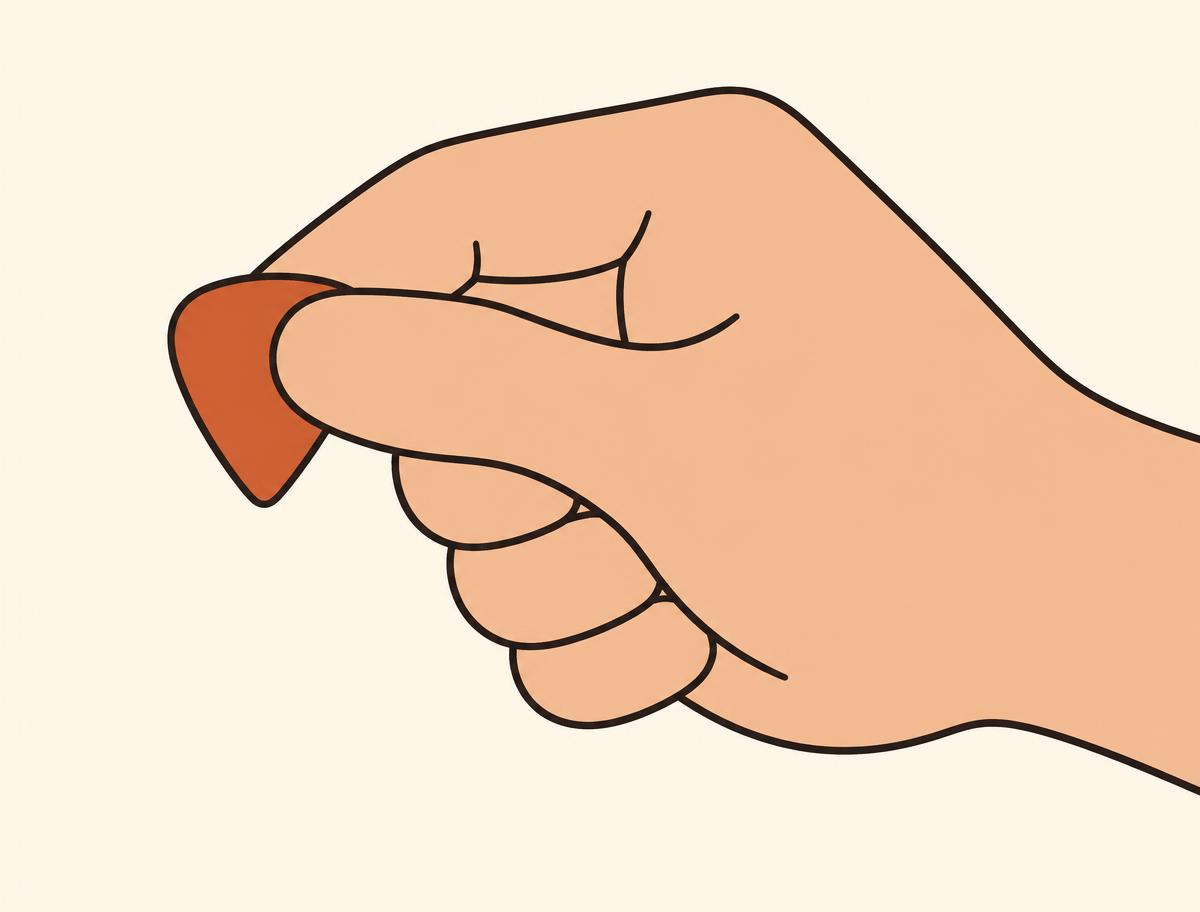
A pick that is held badly makes every note sound weak and uneven. This is the grip most players use — practise it before you try to play anything.
- 1Make a loose fist with your picking hand and let your index finger curl naturally.
- 2Lay the pick flat on the side of your index finger, near the tip, with the point sticking out the bottom.
- 3Press the flat pad of your thumb on top of the pick, holding it against your index finger.
- 4Only about 5mm (a quarter inch) of the pick should stick out — any more and it catches on the strings.
- 5Keep your remaining fingers relaxed and curled; don't press them against the strings.
- 6Pick using a wrist motion, not by swinging your whole arm from the shoulder.
Tuning: E A D G B E
Tune every time you sit down. An out-of-tune guitar makes you sound wrong even when your fingers are right, and it trains your ear against the correct notes.
Hear the six open strings
Tap a string, then pluck your real string and match it. If your string sounds lower (duller, looser), tune it up until it matches this pitch.
No sound? Turn your device volume up and make sure the tab isn't muted. These are reference pitches, not a live microphone — your tuner reads your actual guitar.
Method 1: a clip-on tuner (~$15)
- 1. Clip the tuner to the headstock of the guitar so it can feel the vibrations.
- 2. Pluck one string on its own and let it ring.
- 3. Read the letter it shows — that is the note you are nearest to.
- 4. The needle tells you the direction: left means too low, right means too high.
- 5. Turn the peg slowly until the needle sits in the middle on the note you want.
- 6. Repeat for E, A, D, G, B, E — then go back over all six once more.
Method 2: the 5th-fret method (no tuner needed)
Once one string is in tune, the rest of the guitar tunes itself against it. Press the fret shown and match it to the open string next to it.
| Start on | Press | Match it to |
|---|---|---|
| 6th string (low E) | 5th fret | open 5th string (A) |
| 5th string (A) | 5th fret | open 4th string (D) |
| 4th string (D) | 5th fret | open 3rd string (G) |
| 3rd string (G) | 4th fret | open 2nd string (B) |
| 2nd string (B) | 5th fret | open 1st string (high E) |
The G string is the one exception: it uses the 4th fret, not the 5th.
Three tuning habits that matter
- Always approach from below.If a string is too high, loosen it well below the note, then tune back up. Tuning down onto the note leaves the string slack and it drifts flat.
- Tune after you play, too.New strings and fresh weather both pull a guitar flat. A quick second pass after playing catches what you missed.
- Turn the pegs a tiny bit at a time.Small turns, then pluck again. Yanking a peg past the note is how strings snap.
Your first practice session: 10 minutes
Minutes 0–3
Tune up
Use the clip-on tuner, then check yourself against the reference pitches above.
Minutes 3–5
Set your posture and grip
Sit properly, rest the guitar on your thigh, and hold the pick. Check each point in the lists above.
Minutes 5–8
Hear the open strings
Play all six on the guitar, one at a time, low to high. Say the note name out loud as you play it.
Minutes 8–10
Pick an open string cleanly
Slow single strokes on one string, then two strings. Aim for an even sound, not speed.
What to do next
You now hold the guitar, hold a pick, and can get in tune. Next: learn what the open strings are called on paper, then start reading notes.